Please visit the Multicultural Jew Blog at its new website:
http://multiculturaljew.com/blog
See our latest post: What's In A Name?
To read more about Jewish culture, be sure to sign up for Muticultural Jew's RSS feed.
See you there!
Thursday, December 26, 2013

Wednesday, September 25, 2013
The Multicultural Jew: Ethiopia's Falash Mura: The Ongoing Struggle for a...
The Multicultural Jew: Ethiopia's Falash Mura: The Ongoing Struggle for a...: Ethiopia's remaining Zera Israel community is still in Gondar, and still hopeful.
Tuesday, September 17, 2013
Ethiopia's Falash Mura: The Ongoing Struggle for a Jewish Home
 |
| Zera Israel community, Gondar, Ethiopia. Photo by Vanessa |
But in one sizable community this year, that certainly wasn’t the meaning of Rosh Hashanah. The past won’t be something to shirk or to overcome, but something embrace, and possibly, to fear.
Most of us can’t imagine what the Ethiopian Jewish community of Beta Israel ( who are often referred to by the pejorative name Falash Mura but are properly called the Beta Israel, and their descendants, the Zera Israel) has gone through for the last 36 years, since the first airlift of refugees were taken to Israel in the 1970s. I, myself, find it difficult to comprehend what it must have been like to flee persecution in Ethiopia and moved en mass to a foreign city, only to wait a whole lifetime for a rescue that never came; to watch my children and grandchildren grow up in unexpected poverty, waiting for “fellow Jews” to return and rescue them; to be nurtured with expectation, classes, a synagogue and all the furnishings of a proper Jewish community so that when I and my children and my children’s children finally arrived in the Promised Land, we would know how to “properly” live as Jews.
 |
| A new immigrant (2009) The Jewish Agency |
It closed the school, gave it away to a foreign secular agency and took away the synagogue that had served as religious and cultural lifeline for another 7,000 Zera Israel community members. By the end of the High Holy Days, the Jewish Agency will no longer be providing a synagogue.*
Those that remain Israel says, don’t need the school or the synagogue, much less any community support, because they are not Jewish.
Let’s be clear about this: Those remaining families have been worthy of fostering hope for the last 36 years. They received schooling in Jewish culture because they were part of the Beta Israel Jewish community and presumably had links that suggested their ancestors had at one time, practiced as Jews. As a result, these 7,000 were taught how to pray as Jews and encouraged to abandon any other affiliation they had been raised with. They were encouraged to live as Jews, to cook as Jews, and to practice as Jews. Many of them endured persecution and discrimination as Jews just like those who were airlifted to Israel.
But because they cannot show Jewish lineage or demonstrate a familial link with someone in Israel (and there are millions of Jews throughout the world who know what that is like due to the Shoah), they aren’t considered eligible to be rescued and to join their community.
 |
| A synagogue in Ethiopia. Marc Baronnet |
 |
| Arrivals, 1991. Govt Press Office, Israel |
But when have human and financial limitations ever stopped Jews from living up to the moral imperative that they started?
And when did we become so sure of ourselves as a people that we could define not only who is Jewish, but who, after generations of living as Jews, have the right to continue to pray as Jews?
In a recent Tablet Magazine article, one dejected community member asked how they will continue to pray without a synagogue – and what the purpose is of being Jewish, if there is no synagogue.
“There will be no Jews living here if there is no synagogue,” he said. “When there are no more Jews living and praying together, Shabbat is nonsense.”
I found myself wondering how a community that had existed for thousands of years without outside affirmation could now have that point of view. Didn’t they remember that it was the minyan, not the structure that gave one the ability to pray?
 |
| An Ethiopian gentleman in Israel - Israel Assoc. for Ethiopian Jews |
What changed?
That’s the question that Israel, and the Jewish Agency for Israel, need to ask themselves. How could a self-realized Jewish people be allowed to lose their hope in being Jews after thousands of years? Whether someone else recognized them as Jewish, the thing that allowed Israel to find and rescue the Beta Israel Jews, is that they never lost faith in their belief in Judaism.
 |
| A Israeli reuniting with his daughters during 2009 airlift. Jewish Agency |
* As of the first week in September, the synagogue was taken over by Hatikvah, a community organization appointed by the Zera Israel community members to oversee the continuation of services and access to the synagogue. Services are continuing, particularly through the holidays.
Meketa, a relief organization that has been working with the community, says that the Jewish Agency has ceased its work in Gondar. Support, Meketa says "is even more vital now that the Jewish Agency has ceased its operations."
Next post: The relief agencies assisting the remaining Zera Israel, and what others can do to assist.
Friday, June 7, 2013
Jerusalem's Threatened Soul
 |
| Photo: David Majewski |
This blog has, since its start, been focused on highlighting
the multicultural nature of the Jewish people, an aspect of our history that I
think is often overlooked. While some may see the diversity of Jewish customs
in Israel
and the Diaspora as a controversial issue and a basis for conflict, I see it as
a motivator for dialogue, an inspiration for defining the commonality that
links us all. After all, diversity speaks to the richness and wisdom of a
culture as much as it does to the unexplained and often minor differences of
opinion.
 |
| Kessim (Ethiopian Jews) praying. Photo: Benny Voodoo |
Multiculturalism means that we have been around and survived
long enough to find beauty and adaptability in other cultures, as well as our
own. It means that despite thousands of years of dialogue with other religions
and cultures, we have continued to find our own distinct voice.
But this week I find it difficult to offer a story from
which to draw motivation and promise. Not because there aren’t many still to be
explored. North America, South America, Africa, Europe, Asia and of course the Middle East all offer tales of the prevailing Jewish
experience.
This week, like many Jews across the globe, I find my
attention drawn to another, much sadder incongruity.
Last Monday the Chief rabbis of Israel, and the administrator of
the Kotel received letters threatening them with bodily harm “if the Women of
the Wall are not allowed to pray in accordance with (their) customs.” The letter contained the image of a handgun, along
with the words, “your end is near.”
Equally disturbing was the fact that the letter was penned in
the name of Women of the Wall. For their part, the organization immediately
issued a press release condemning the letters and disavowing any knowledge or
responsibility for the act.
Like everyone else, I of course want to know who the author
is of this unsettling letter. After all, it’s human nature to want to get to
the “bottom” of something disturbing, if only to reassure ourselves that it is
“under control.”
But while Israel’s
security personnel will no doubt be investigating that question with speed, it
seems to me that the real issue at hand isn’t who did it, but how. How a Jew – any Jew – could possibly see this
as a viable path to our self preservation as a religious people.
Many, like I, doubt its purported source. A few writers have
ventured down the path of accusations, suggesting either outright or in veiled
language that an organization that has spent the better part of 25 years
fighting in the courts for the right to peacefully pray in public could, on the
dawn of their accomplishments, throw it all away for one vindictive letter.
It’s an argument that makes no sense.
 |
| Photo: Michal Patelle |
Those who have followed WOW’s journey over the past 25 years
know that a defining characteristic of their efforts has been their commitment
to pluralism and to peaceful unity of the Jewish people, particularly at the
Kotel. These are virtues that even in the midst of conflict defy an act like
this.
Even when pelted by rocks, disrupted by the clamor of chairs
being thrown at them, attacked and accosted with slurs while they prayed, they
have never campaigned for anything but peace and tolerance, particularly at the
Kotel.
Even on the rosh chodesh Sivan, when they were
threatened by angry crowds that were more than ten times the size of their
gathering, there was no effort to fight back or to return the threats they
received. They entered peacefully and the departed just as they had arrived:
ringed by security, no doubt frightened and wary for their safety, but resolved
in their belief that Judaism’s many movements and beliefs can indeed share space
and share unity.
Since that time, rabbis and cantors across the world, some
who share the movement’s goals, and others that are still wary of a
non-Orthodox tradition, have spoken out to condemn the threats. Many have
defended WOW as an organization that eschews violence and is dedicated to
pluralistic thought.
So have journalists. Even conservative-leaning Israeli
publications like the Jewish Press were willing to ask whether someone could be
“framing” Women of the Wall, something that its writer Tzvi ben Gedalyahu
admits could be the case, despite his criticism of WOW’s liberal values.
But again, the question seems to be not “who” but “how”: How
could we have arrived at this point?
As Jewish history has unfortunately already proven, in the end religious conflict is never a matter of one against the other, or who wins and who loses. History may appear to keep count, but loss is always inestimable, always profound.
A pluralistic society can’t succeed if only some of us want
it. It also can’t grow if we hold grudges against those who fear its message. Pluralism
speaks not just to who we are or who we want others to be, but who we become
when faced with the disappointing reality that we still have farther to go in
being accepted for our views. As Rabbis for the Women of the Wall*so eloquently
demonstrated in their June 4 letter of support to the Chief Rabbis in Israel:
“It is deeply disturbing that at this point, when negotiations
about freedom to worship at the Kotel are taking a new turn, such a threat
should be issued. May the Chief Rabbis of Israel be
sheltered beneath the wings of Shechinah, along with those who seek to
pray in peace. May they have the courage to model open-mindedness and love of
all their people.” 1
“May those who sincerely support religious pluralism be
blessed, so that bim'heirah, b'yameinu (soon in our day), Ultra-Orthodox,
Orthodox, and non-Orthodox Jews may be able to pray in safety and dignity. Ken
y'hi ratzon. (So may it be.)” 2
* Also known as Rabbis Support Pluralism
1Rabbi Peg Kershenbaum, The Association of Rabbis
and Cantors and International Vice Chair of Rabbis for the Women of the Wall.
2Rabbi Yocheved Mintz of the Reconstructionist,
Renewal Congregation P’nai Tikvah in Las
Vegas Nevada, and
International Vice Chair to Rabbis for the Women of the Wall.
 |
| Photo: Julien Menichin |
Sunday, May 12, 2013
The Kotel: Carrying Forth the Prayer
 |
| Women of the Wall during a previous Rosh Chodesh - Photo by Tanya Hoffman |
And each one would know that on Friday, May 10, 2013 more than any day in the past 25 years, her presence and her courage would be needed at the Kotel. Whether she was afraid didn’t matter. What mattered was her presence and her prayer.
 |
| The Kotel circa 1942 - courtesy of Podnox |
The idea that crowds of people could actually be angry with a group of Jewish women for praying at the Western Wall seemed amazing to many who watched the events unfold on their computer screens that night. Jews – both women and men – have been coming to the Kotel to pray, to seek refuge and to reaffirm heritage for thousands of years. Reform, Conservative, Reconstructionist and Renewal Jews have davened at the Kotel for decades, if not centuries, just as have an equally diverse spectrum of Orthodox and Haredi Jews.
 |
| Photo by Andy Ratton |
But what seemed incomprehensible to me was not that there had been feelings of betrayal and scorn toward the court decision to let women don tallisim at the Kotel, but that on a day that Jews everywhere attached to spiritual expression, there was anything but joy being expressed at the foot of the Kotel.
“Rosh Chodesh,” explains Chabad on its website, “means the “head of the new (moon),” and indeed it is a day—or two—of celebration marking the start of a new lunar month.”
 |
| Photo by Shoshanah |
Monday, May 6, 2013
Women of the Wall: Latest Developments

One couldn’t help pick up the sense of optimism and excitement in the organization’s this last Sunday's press release, either, noting that support is gathering for a women's Rosh Chodesh service, May 10, with transportation plans for attendees already in the works.
It will be interesting to see how many turn out and what kind of reception the group receives at the wall now that they are permitted to wear their tallisim.
In an interview earlier this month, board member Cheryl Birkner Mack noted that complaints and interruptions of Women of the Wall services only seem to occur when their attendance has been previously announced. She said that when the women’s group has turned up without announcing it on their website or in a press release they have been able to pray together without police or bystander interference.
"The real proof I have … is that we have on occasion, including about three months ago, gone unannounced (to pray at the Kotel) on a day that was not Rosh Chodesh and encountered no opposition, no problem, no police, no security, nobody at all coming over and saying what you’re doing is forbidden," said Birkner Mack, who suggested that those who seemed bothered by the service know that they could easily adjust their arrival time to miss the hour or hour-and-a-half prayer services.
But now that the group has the law on their side so to speak, have things changed?
 |
| Torah service, 1980s. Women of the Wall |
A new women’s organization has also stepped up to the plate to announce its objection to the 25-year-old organization’s presence at the Wall. Women FOR the Wall (better known as W4W), says it wants to ensure that “the experience (of praying at the Wall remains) profoundly meaningful” for all women. It’s unclear whether this means that women who wish to hold an integral service of their own and don tallisim are not welcome in the women’s section.
Multicultural Jew will be following these developments this week, and will follow up with our new interview with WOW on Sunday May 13 Pacific Time.
Please share your own thoughts on this matter. Is Women of the Wall speaking for you? Are they speaking against what you believe?
 |
| Photo courtesy of Michal Patelle |
* Shortly after posting, Women of the Wall released a statement on its FaceBook page concerning earlier announcements by the attorney general and minster of religious affairs. It would seem that WOW's confidence that its major battles were over was premature.
It is indeed a troubling time in the Jewish homeland.
Share your thoughts; Israel's unity thrives through dialogue. What do you think will inspire consensus?
Thursday, April 25, 2013
The Jews of Argentina: Templo Libertad, Buenos Aires
 |
| Photo by Active Steve |
Just off one of Buenos Aires busier streets, flanked by shaded trees and a carefully obscured Jewish museum stands the city’s first synagogue. Its tall stone walls and impressive front speak of auspicious years when immigrants from all over the world flooded into Argentina’s burgeoning streets.
In fact, the Congregación Israelita de la Republica Argentina, or Templo Libertad (Temple Freedom – which gets its name from the street it is on, Calle Libertad) as the synagogue is more affectionately called by its members, began long before most of those stone walls were constructed, in a time when the permanence of a synagogue, like the assurance of a minyan of worshipers was still a hopeful goal.
To this day, all of the names of the synagogue’s first minyan are shrouded in mystery. Yet their actions, however idealistic and bold, set the groundwork for a community that would eventually reach into the hundreds of thousands.
 |
| Palacio Miró, demolished 1927 |
“But the collected funds were not enough,” says the website’s author, Victoria, “and they decided to sell the property and purchase this site, which in those days was located across from the Palacio Miró.” The foundation stone was placed in 1897, and Buenos Aires first synagogue was born.
 |
| Buenos Aires in the 1920s, looking toward Templo Libertad |
Realizing the community would need a larger synagogue, the members began to plan for its expansion. They turned toward the images of their homelands: the influences of Romantic and Byzantine architecture that at one time flourished throughout Europe. They hired the best architects for the task and seemingly spared no expense. The old synagogue was reconstructed with an eye toward the grandeur of its surroundings, the Miró Palace, across from the temple, and the world renowned Colón Theatre, just down the street.
 |
| Photo by Robert Cutts |
Today, approximately 80 percent of Argentina’s Jewish residents are Ashkenazi - an unusual characteristic in Latin America, where many communities have retained the Sephardic customs of their family’s Spanish ancestry. But the Buenos Aires’ Jewish community has also experienced dramatic changes over the years.
As time went on, El Once’s predominantly Orthodox neighborhood began to shrink. Families left the neighborhood – and the shul – for other regions of Buenos Aires. New communities in areas like Belgrano and Palermo, north of the temple, began to spring up.
“(Thousands) and thousands of Jews moved to those areas and established their houses there, their new synagogues and Jewish life, both Conservative and Orthodox,” Kripper says. “It was, I would say, a revival of Jewish life, particularly among young people.”
The Orthodox traditions fell away – temporarily.
 |
| Nearby Buenos Aires - Today - Stanley Wood |
But support for Israel, says Kripper, stayed strong, becoming a vital link to Jewish culture. A community that was once devoutly traditional and insular, gradually became “secular, Zionist oriented in terms of Jewish education, Jewish life, and very linked to the state Israel.”
In the last 30 or so years, however, Buenos Aires has gone through another change. The introduction of a Conservative seminary in 1962 helped to plant the seed for a religious revival – a revival that would eventually reach even as far as Buenos Aires’ grand synagogue Templo Libertad.
“The traditional service … serves the needs and expectations of the older generations,” Kripper says, “the people who used to go to the main sanctuary, and were used to the big religious show by the cantors,” complete with an electric keyboard. “But their style of davening, of praying … is still along the lines of the old school of German Jewry.”
The temple’s main cathedral-style sanctuary is now home to a larger, more liberal service on Shabbat that Kripper says is led by graduates of Argentina’s Conservative seminary, the Seminario Rabínico Latinoamericano Marshall T. Meyer, based in Buenos Aires. Its services meet the needs of Buenos Aires’ up and coming younger population, the products of the city’s newer outlying neighborhoods.
 |
| Commemorating the mourned* - Pablo D Flores |
And even during the community’s most cataclysmic changes, it never lost sight of its heritage or the value of believing in something larger than what it had left behind. Perhaps it is because of that overly optimistic Jewish value that even amid tragedies and continuing changes in how we define ourselves, our sense of Jewish identity never leaves.
 |
| Photo by Robert Cutts |
* The banner commemorates those who were killed in the 1992 bombing of the Israeli Embassy and the 1994 attack on the Jewish Community Center, both in Buenos Aires. The banner signifies the 22 killed in the embassy bombing and 85 lost at the Jewish community center. The six million is a reference to those who are mourned from the Shoah (Holocaust). The photo was taken in Rosario, Argentina.
Gratitude is expressed to Rabbi Daniel Kripper for his willingness to be interviewed for this series of posts on Argentina's Jewish Communities.
Friday, April 19, 2013
The Multicultural Jew: Women of the Wall and Diversity at the Kotel
The Multicultural Jew: Women of the Wall and Diversity at the Kotel: For many Jews in the Western Hemisphere, the beginning of a new month on the...
Thursday, April 18, 2013
Women of the Wall and Diversity at the Kotel
 |
| Women's Section at Kotel - Photo by Silversteinb |
So it is often difficult to understand in these modern times, how the change of a single date could, with one chosen action, get someone arrested.
 |
| Photo by Michal Patelle |
 |
| Photo courtesy of Women of the Wall |
 |
| Photo by Michal Patelle |
And rabbinical and legal limitations are not the only obstacles they face when they turn up. There are threats, condemnations and outward attacks from their critics.
There are attempted burnings of their materials by enraged bystanders (as occurred last week). And most recently, there are restrictions to their ability to perform Kaddish in public, one of the most sacred prayers of Judaism (although according to Cheryl Birkner Mack, a spokesperson for the group, it is not their custom to say the prayer at the Kotel at this time).
 |
| "Riot" - Photo courtesy of Women of the Wall |
Majority rule? In Jerusalem, or in Israel as a whole?
Affiliation and religious practice have always been difficult issues to quantify in Israel, particularly since Conservative and Reform Jews are generally not counted as such in Israeli census, and because of the historic debate over the appropriateness of taking an accurate census of the Jewish people. So there is a fair amount of variation in results depending on whose figures you use.
But according to a 2009 survey (page 30) published by the Israel Democracy Institute, only 7 percent of those surveyed throughout Israel identified themselves as Haredi (up from 5 percent in 1999). The number who claimed to be Orthodox were barely more than twice that – 15 percent (11 percent in 1991). Jews who defined themselves as “traditional” numbered more than twice the Orthodox (32 percent/33 respectively). For the purpose of the IDI survey, the religious affiliations of those who maintained “traditional” customs were not defined.
 |
| Photo by Naamanus |
Haredi affiliation is substantially greater inside Jerusalem than in Israel as a whole. According to the City of Jerusalem’s 2009 figure, 21.3 percent, or 165,000 of the total municipal population (772,982) identified themselves as Haredi, while 497,036 identified themselves as Jewish in general. The city points out in footnote that the accepted statistic that is generally applied to Haredi residents within the city of Jerusalem is 30 percent.
But try as they might, statistics often don’t tell the whole story about a people, and this is certainly the case when it comes to Israel’s complex understanding of minhag. So what about history? Can Jerusalem’s significant Jewish history help define what should be considered local custom?
Several writers have posed this question, including Bonna Devora Haberman, one of the group's organizers following its start in 1988. Tradition at the Kotel, Dr. Haberman says in her book, Israeli Feminism Liberating Judaism, isn’t as much a custom of place, than a coexistence of conventions:
 |
| Photo by Leif Knutsen |
The website and nonprofit group, Be’chol Lashon (In Every Tongue) echoes this statement in its introductory description, The History of Jewish Diversity.
“Today, Israel is one of the most racially, ethnically, and nationally diverse countries in the world, with immigrants from over 70 countries.” The author goes further to point out that “the story of the Jewish people is filled with interracial and intercultural mixing.”
 |
| Photo courtesy of Israel Defense Forces |
So how can there be one definitive minhag at Israel’s holiest prayer site?
Haberman notes that “Until Israeli sovereignty, there had been no separation between men and women at the Western Wall.” She goes on to explain the events that unfolded in 1968, a year after the Kotel had been reclaimed by Israeli forces, that brought about the changes to minhag at the Western Wall.
 |
| Photo by Saga Olsén |
So how can there be a minhag that supposedly defines historical practice at the Kotel?
 |
| Art work by Ephraim Moses Lilian |
 |
| Photo by Beggs |
But realistically, it will likely take many years before such a concession could become part of the minhag hamakom at the Kotel. And while the “new” women’s section that has been proposed with the help of Natan Sharansky may offer an option, one must ask whether this idea - which will take years to implement - is a compromise for both sides or a palliative measure that excuses one from recognizing the rights and human needs of another.
As Daniel Atwood, a writer for Yeshiva University’s publication The Commentator expressed in his March 10, 2013 editorial, “Ironically, it is baseless hatred of other Jews that the Gemara faults as being the cause of the destruction of the Second Temple,” which the writer points out once stood footsteps from the portion of the Kotel that remains today. “Hopefully a solution will come about that recognizes the diversity of Jews who pray at the Kotel,” and, he points out, without making those who are more conservative in their beliefs feel uneasy in their place of worship.
“Hopefully each side will be willing to accept such a compromise.”
Update: On April 25, 2013 the courts ruled in favor of the Women of the Wall's right to pray at the Kotel, by supporting the Magistrate's Court decision of Judge Sharon Lary-Bavly that the five women who were arrested on April 11, 2013 for praying out loud and for wearing prayer shawls should not have been detained, and that they had not disturbed public order. Judge Moshe Sobel, who had reviewed the case in response to a police appeal, also found that:
- the earlier recommendation that the Women of the Wall pray at the Robinson's Arch did not mean they could not pray in the women's section of the Kotel;
- their choice to pray in the women's section does not imply they have committed a criminal act;
- they are not violating a law concerning "minhag hamakom (local customs). "(Legal) proceedings of Women of the Wall establish that the “local custom” is to be interpreted with National and pluralistic implications, not necessarily Orthodox Jewish customs (per Women of the Wall press release);
- if they were to be found disturbing public order it doesn't mean they endangered public peace.
Please see next week's posting (May 5) for follow-up information on the Women of the Wall.
Sunday, March 24, 2013
Thursday, March 21, 2013
Passover: The Finding Consistency in a World of Diversity
I love Passover. I probably wouldn’t be alone in saying that it remains my favorite Jewish holiday. It has richness, it has beauty and it has heart-wrenching depth.
But that isn’t really why it’s my favorite celebration. It’s because of the amazing diversity of its traditions and its ever changing capacity for expression.
Diversity, you say? If anything, Jewish traditions are rooted in consistency, not diversity. Each year we tell the same story, we eat pretty much the same foods, we symbolize the story of the Jews’ exodus with the same items on the seder plate, we break and hide the matzah the same way.
True, within our individual communities we generally do. And don’t get me wrong: that consistency is what gives value and depth to the Passover holiday. By adopting the traditions that our great-great-grandparents followed, we give them meaning and purpose. We keep them alive, and they in turn, keep our Jewishness alive.
But I still can’t help but be fascinated by the breadth of changes our simple Passover meal has gone through over the years. As Jews have travelled throughout the world, they have tweaked the customs to fit the abundance and limitations of their new homelands. In some cases, they had no choice: in their migration from one culture to another, one climate to the next, the availability of ingredients changed, and so did the recipes and the traditions. Jews who were expelled from Spain during the Inquisition are known to have settled as far away as Mexico (and to have added to the recipe a tropical flavor), Italy (with its interesting addition of citrus and dates), Greece (with pine nuts and sans apple) and parts of Eastern Europe (what is often considered the conventional Ashkenazi charoset, with apples and often missing the citrus of some Sephardic recipes).
Today, this discovery and transformation continues. Each year, as I sweep out the last crumbs of chometz from my cupboards and plan the menu for our seders, I put aside time to log onto the Internet and take a tour around the Jewish universe. I learn about Jewish cultures I’ll probably never visit, I try to imagine what their beginnings were like. I travel to Cuba, where charoset has for years been a humble mixture of matzah, wine and honey – a charoset of the oppressed. What was it like before apples became too expensive to use? Was it something richer, more decadent? And 100 years from now, will that simple mixture of matzah, honey and wine with its own concoction of spices take on a richer, bolder significance and resist change, or will it be transformed by history once again?
I find myself wondering how the last remaining Ethiopian Jews in Gondar will celebrate the holiday this year, knowing that most, if not all, will be in Israel next year. How will their understanding of Jewish customs change, or will some of them remain steadfast, and manage to hold on to their traditions of thousands of years?
And what new communities will emerge next year? This Passover, on the small Portuguese island of Madeira, what is believed to be the first public seder in several hundred years will be taking place. Shavei Israel and a gracious couple from Israel, Danby and Marvin Meital, will be hosting the seder in its well-known resort. Even though the original community no longer exists (there are rumored to be two or three Jewish families living on the island), its ancient Jewish history makes Madeira a fitting place to hold the Passover celebration. In attendance will be people representing many different backgrounds, and possibly, many different Jewish customs. Once again Jews will have a chance to preserve a part of Jewish history by enriching it with their own unique and vibrant understandings of what it means to live and to celebrate the Jewish experience.
Video of Bnei Menashe singing V'hi she'amda at Pesach courtesy of Shavei Israel.
But that isn’t really why it’s my favorite celebration. It’s because of the amazing diversity of its traditions and its ever changing capacity for expression.
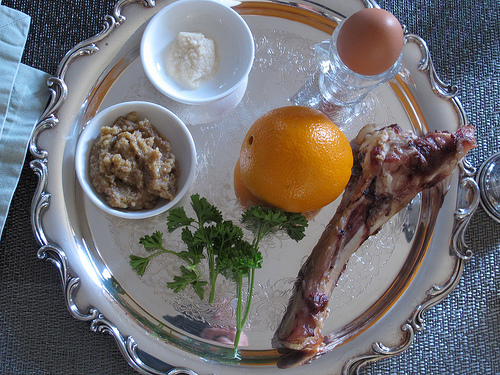 |
| Modern day Ashkenazi seder plate - Eden Hensley Silverstein |
True, within our individual communities we generally do. And don’t get me wrong: that consistency is what gives value and depth to the Passover holiday. By adopting the traditions that our great-great-grandparents followed, we give them meaning and purpose. We keep them alive, and they in turn, keep our Jewishness alive.
But I still can’t help but be fascinated by the breadth of changes our simple Passover meal has gone through over the years. As Jews have travelled throughout the world, they have tweaked the customs to fit the abundance and limitations of their new homelands. In some cases, they had no choice: in their migration from one culture to another, one climate to the next, the availability of ingredients changed, and so did the recipes and the traditions. Jews who were expelled from Spain during the Inquisition are known to have settled as far away as Mexico (and to have added to the recipe a tropical flavor), Italy (with its interesting addition of citrus and dates), Greece (with pine nuts and sans apple) and parts of Eastern Europe (what is often considered the conventional Ashkenazi charoset, with apples and often missing the citrus of some Sephardic recipes).
 |
| Ashkenazi charoset - by Wonderyort |
 |
| Israeli seder for Ethiopian Jews - Jewish Agency for Israel |
And what new communities will emerge next year? This Passover, on the small Portuguese island of Madeira, what is believed to be the first public seder in several hundred years will be taking place. Shavei Israel and a gracious couple from Israel, Danby and Marvin Meital, will be hosting the seder in its well-known resort. Even though the original community no longer exists (there are rumored to be two or three Jewish families living on the island), its ancient Jewish history makes Madeira a fitting place to hold the Passover celebration. In attendance will be people representing many different backgrounds, and possibly, many different Jewish customs. Once again Jews will have a chance to preserve a part of Jewish history by enriching it with their own unique and vibrant understandings of what it means to live and to celebrate the Jewish experience.
 |
| Jewish Quarter, Lisbon, Portugal - Carnaval King 08 |
Video of Bnei Menashe singing V'hi she'amda at Pesach courtesy of Shavei Israel.
Friday, December 14, 2012
In Defiance and Faith: Lighting the Hanukkah Candles in Public

For thousands of years, Jews have been lighting their Hanukkah menorah outside or in front of their windows for the rest of the world to see. Jews take great pride in this public ritual, which sometimes garners criticism from those who are uncomfortable with the public display of an age-old religious tradition. But Hanukkah as a holiday is unique: lighting the menorah in public is a mitzvah. Whereas we bless the candles of most other holidays at dinner table and in the secluded privacy of our homes*, we are specifically directed to publicize the celebration of Hanukkah where others can see.
Hanukkah and Anti-Semitism
Even when there has been evidence of anti-Semitism in the community, Jews have fulfilled this mitzvah. Nor has the ritual changed much over the years. According to Professor Moshe Benovitz, during the Talmudic period the candles were traditionally lit outside one’s home.
Benovitz notes in his paper (to be found in Menachem Mendel's blog post of the same name), Hanukkah: Holiday of Hearth and Home that over the years the tradition was largely moved indoors, particularly in Ashkenazi communities. Benovitz offers several historical theories for this change, including persecution from non-Jewish neighbors. But it is interesting that even after the Shoah (the Holocaust) and the forced relocation of Jews throughout the Diaspora on numerous occasions, Jewish communities have continued to light the chanukiah where the public can witness this testament of faith.

The Orach Chaim, a section of the Shulkhan Arukh, which was compiled in its final form by Rabbi Yosef Karo, serves as an authoritative reference for halachot (laws) concerning Jewish holidays. It provides an exception for public lighting of the candles in times of public distress or difficulty.
“One should place the Chanukah lights at the entrance which is next to the public area, on the outside of the entrance,” says the Orach Chayim. It goes on to explain other options depending upon where the resident lives, including placing the menorah in a window if a public area for lighting is not available.
“However, “(when) in times of danger,” the Orach Chayim notes “… he should place the Hanukkah lights on the table and that is sufficient.”
Lighting the Candles in Times of Danger
So what constitutes “times of danger?” The Orach Chayim qualifies it as living where “there are evil rulers who do not allow one to fulfill the mitzvah.” Does the evidence of unlawful attacks from anti-Semitic groups (e.g. those not sanctioned by any presiding government) constitute times of danger? Should fear of persecution be a guiding principle in such instances? It is worth noting that even in cases in which Jews are being ordered not to celebrate Hanukkah, according to the Orach Chayim, the mitzvah of lighting the Hanukkah candles still takes precedence.
Does the fact that one lives in a democratically ruled country with laws against hate crimes mean that one should never alter this mitzvah?

Or is it because Hanukkah is a way of demonstrating the Jewish community’s resistance toward persecution: a form of defiance as well as a form of public worship?
The Federal Bureau of Investigation’s report on hate crimes (for 2009) states that 72 percent of all hate crimes in the United States were due to the "offender's anti-Jewish bias." ** Yet U.S. and Canadian Jewish communities have developed around the concept that living in a democracy does not require the drastic measures of hiding one’s traditions. More: that their public demonstration helps to educate other communities and promote multiculturalism.
The Hanukkah Menorah and Multiculturalism
Interfaith groups, and Jewish organizations directed toward narrowing the gap between Orthodox, Conservative and Reform Jews have endorsed this view. So has the Hassidic rap artist Matsyahu, who incorporates Jewish symbols, beliefs and traditions into his songs. Being proud of one’s Jewishness can help to reverse stigmatizing, and being willing to share one’s holiday traditions can break down barriers to communication.
As this writer has found, Hanukkah can serve as a powerful bridge between two cultures. Yet the appropriate medium sometimes depends upon the circumstances. In one small town in western Colorado, my family elected to light the candles in a window that did not face the main street because of a history of anti-Semitic behavior by some members of the community. We fulfilled the mitzvah, although cautiously, preserving its view for those who were not threatened by our celebration.
Had it not been for a more fulfilling community experience some years before, our tradition of lighting the candles in front of a public thoroughfare might have been affected by this event. But we had already learned that the Hanukkah menorah carried an important message of support, not only for Jews, but for others as well.

The Festival of Lights
Shortly after my husband’s graduation from university, we moved to a small town in the interior of British Columbia, Canada. Each Hanukkah we placed the lit menorah in the front window of our house. The first year brought carloads of curious neighbors past our front steps. The town in which we lived was primarily First Nations, and many had never seen the chanukiah, much less heard its ancient story. To many, our Jewish tradition reaffirmed our bond with our neighbors, whose ancestors had also endured decades of cultural discrimination and for many years had been prevented from practicing their own traditions, or even speaking their native language. Our new friends were amazed to find that Jews had experienced the same fate many years ago, and were now able to share their holiday traditions in most areas of the world without fear of persecution.
My family and I lit the Hanukkah menorah that year as Jews. By the end of those eight days however, we had come away with an even greater understanding of our connection with those around us.
The ancient rabbis were well versed in the dangers of anti-Semitism, and therefore left an “out” for Jewish families at Hanukkah during times of conflict. But as many Jews have found throughout the years, sharing the defining elements that make one a Jew can also open doors to the common histories that make us human.

*At
Succot we light the Shabbat candles outside in a succah, or booth, but still
with the walls and the assigned setting of a private (though temporary)
domicile.
** These
numbers were down to 1,080 incidents in 2011, reflecting a drop of 495 incidents,
and according to the Anti-Defamation League, the lowest drop in two decades
(Anti-semitic incidents decline in the U.S. in 2011 … Huffington Post 11-03-12)
Subscribe to:
Posts (Atom)